Next: Inverse of a Gaussian Up: Miscellaneous notes Previous: Fast Fourier transform in Contents
Let's construct a simple digital band-pass filter based in the sinc filter.
As everyone know, the sinc function is the impulse response
of a low-pass filter. That is, the convolution
of a signal  and the sinc function
 will produce a low-pass filtered signal without frequencies higher than
  . Similarly, the function
 where
where  represents the Dirac delta function, is the frequency response of the ideal high-pass filter of frequency
  .
.
Heuristically, we can right away derive the discrete versions of the impulse responses:

![$\displaystyle i \mapsto \delta[i] - \frac{\sin(2 \pi \frac{B_H}{f_c} i)}{\pi i},
$](img104.svg)
for the high-pass filter. The variable  is the sampling frequency and
![$i \mapsto \delta[i] := \delta_{0i} $](img105.svg) is the Kronecker delta.
is the Kronecker delta.
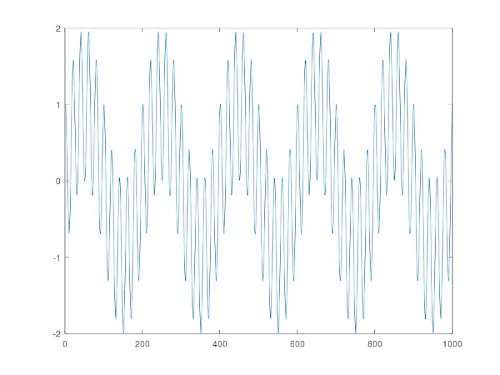
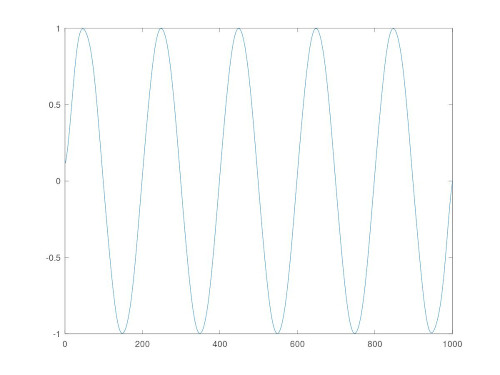
Now, having a discrete signal at hand, band-pass filtering is (in the simplest approach) just a matter of discrete convolution of the signal with the functions above. The following Octave code does the job.
##Sinc band-pass filter. f0 = B_L/fs, f1 = B_H/fs

function filtered = sincfilter(signal, f0, f1)
  if(mod(length(signal), 2) != 0) #Check if the signal length is even or odd.
    signal = signal(1 : length(signal) - 1);
  end

  M = 10000; #Increase this to increase accuracy.
  sincF = zeros(1, M);
  for m =  -M/2 + 1 : 1 : M/2
    if(!(m  == 0))
      sincF(m + M/2) = sin(2*pi*f1*m)./(pi*m);
    else
      sincF(m + M/2) = 2*f1;
    end
  end

  sincH = zeros(1,M);
  for m =  -M/2 + 1 : 1 : M/2
    if(!(m  == 0))
      sincH(m + M/2) = -sin(2*pi*f0*m)./(pi*m);
    else
      sincH(m + M/2) = -2*f0 + 1;
    end
  end

  ##Plot stuff.
  figure(1)
  plot(sincF)
  figure(2)
  plot(signal)

  tic
  filtered = conv(signal, sincF, "same");
  filtered = conv(filtered, sincH, "same");
  toc

  figure(3)
  plot(filtered)
end
For more accuracy and effectiveness, one should use windowed or recursive filters. One can check in the references for more sophisticated methods!
References: